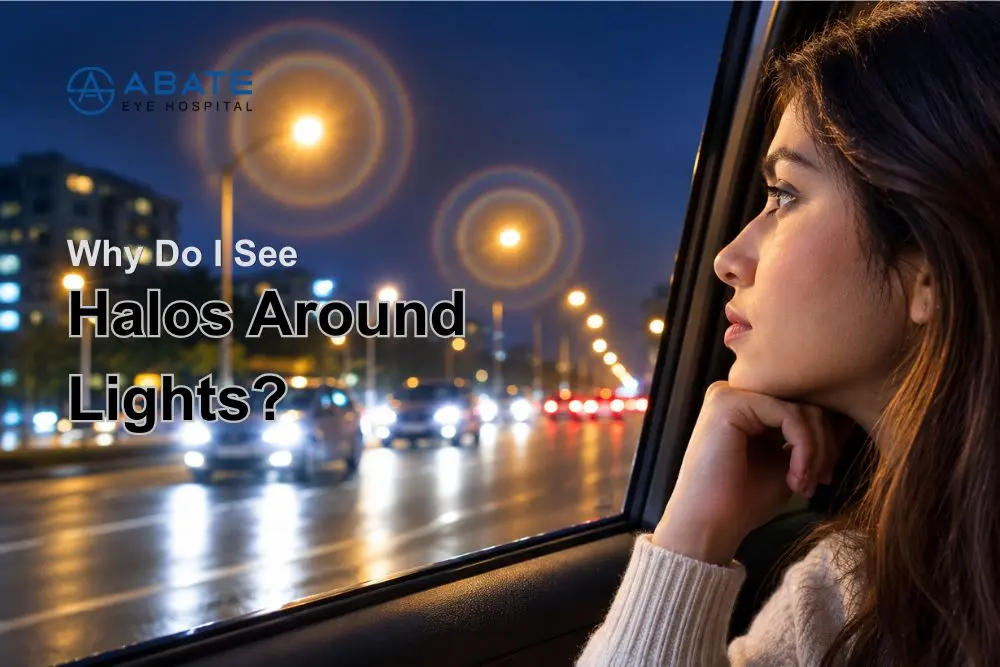
Have you ever noticed bright rings or glowing circles around headlights, streetlights, or other bright objects, especially at night? Seeing halos around lights can sometimes happen temporarily because of tired eyes, dry eyes, or bright light exposure. However, frequent or sudden halos may also be associated with conditions such as cataracts, corneal problems, or glaucoma.
Understanding why halos occur can help you know when they are harmless and when you should consult an eye specialist.
Halos are bright circles, rings, or glowing effects that appear around light sources. They are often more noticeable in dark environments when looking at:
Some people describe them as rings, while others may see starbursts, glare, or rays extending from lights.
Occasionally seeing halos is not necessarily a sign of an eye disease. However, persistent or newly developed halos should be evaluated, particularly if they occur along with other vision changes.
There are several possible reasons for seeing halos.
Dry eyes are one of the common causes of temporary glare and halos. An unstable tear film can affect how light passes through the surface of the eye.
You may also experience:
Long periods of screen use, air-conditioned environments, and insufficient blinking can contribute to dry eyes.
Cataracts develop when the natural lens inside the eye becomes cloudy. As light passes through the cloudy lens, it can scatter and create halos and glare.
Other common cataract symptoms include:
If halos are becoming more noticeable, particularly while driving at night, an eye examination can determine whether cataracts are responsible.
Astigmatism occurs when the cornea or lens has an irregular shape. Instead of focusing light evenly onto the retina, light may be spread across different points.
This can result in:
Corrective glasses or contact lenses may improve these symptoms when astigmatism is the cause.
Contact lenses can sometimes cause halos, particularly when they are:
If you wear contact lenses and suddenly develop halos with redness, pain, or blurred vision, remove the lenses and seek professional eye care.
The cornea is the clear front surface of your eye. Conditions that affect its clarity or shape can interfere with the way light enters the eye.
Examples include:
These conditions may cause halos, glare, distorted vision, or reduced visual clarity.
Certain forms of glaucoma can cause halos around lights. Acute angle-closure glaucoma, in particular, can cause sudden halos along with severe eye pain, redness, blurred vision, headache, nausea, or vomiting.
This is an eye emergency and requires immediate medical attention.
Some people may experience halos or glare following refractive eye surgery such as LASIK, particularly during the early recovery period.
For many patients, these symptoms improve as the eyes heal. However, persistent or worsening symptoms should be discussed with your ophthalmologist.
Halos are often more noticeable at night because the pupils naturally become larger in low-light conditions.
A larger pupil allows more light to enter the eye. If the cornea, lens, tear film, or other optical structures are not focusing light properly, the resulting glare or halos may become more noticeable.
This is why some people notice halos particularly around car headlights while driving at night.
Occasionally seeing halos does not necessarily mean there is a serious problem. For example, temporary halos can occur because of:
However, new, frequent, or worsening halos should not be ignored. An eye examination can determine whether there is an underlying condition.
You should seek prompt medical attention if halos appear suddenly or occur with:
These symptoms can occur with serious eye conditions, including acute glaucoma.
Yes. Halos and glare are common symptoms of cataracts.
As the natural lens becomes cloudy, light can scatter inside the eye. This may make bright lights appear surrounded by rings or glare.
If you also notice difficulty driving at night, cloudy vision, or increased sensitivity to headlights, schedule a cataract evaluation.
Yes. An unstable tear film can cause light to scatter irregularly as it enters the eye. This can make lights appear blurry or surrounded by halos.
Treating the underlying dry eye problem may improve these symptoms.
Treatment depends on the underlying cause.
Your eye specialist may recommend lubricating eye drops, lifestyle changes, or other dry-eye treatments.
Glasses, contact lenses, or refractive surgery may help correct the problem.
If cataracts significantly affect your vision and daily activities, cataract surgery may be recommended.
Treatment may involve prescription eye drops, laser procedures, or surgery depending on the type and severity of glaucoma.
Treatment varies depending on the underlying corneal problem and may include medication, specialised contact lenses, corneal procedures, or surgery.
An ophthalmologist may perform a comprehensive eye examination that includes:
Additional diagnostic tests may be recommended depending on your symptoms.
Some simple habits may help reduce temporary glare and visual discomfort:
Halos around lights can have several causes, and identifying the underlying problem is important for choosing the right treatment. At Abate Eye Hospital, experienced ophthalmologists provide comprehensive eye examinations supported by advanced diagnostic technology to evaluate conditions affecting the cornea, lens, retina, and optic nerve.
Whether you are looking for an eye hospital in Kerala, an eye hospital in Kozhikode, an eye care hospital in Kannur, an eye hospital in Malappuram, or the best eye care in Chennai, Abate provides personalised diagnosis and treatment for a wide range of eye conditions.
Seeing halos around lights can be caused by something relatively simple, such as dry eyes or an incorrect vision prescription, but it can also be a symptom of cataracts, corneal conditions, or glaucoma.
If halos occur frequently, become worse over time, or are accompanied by pain, redness, sudden blurred vision, or vision loss, don't ignore them. A comprehensive eye examination can help identify the cause and ensure that any underlying eye condition is treated promptly.
Halos may be more noticeable at night because your pupils become larger in low-light conditions. Dry eyes, astigmatism, cataracts, corneal problems, and certain eye conditions can make halos more prominent.
They can be. Cataracts can scatter light as it passes through the cloudy natural lens, causing halos and glare, especially at night.
Yes. An unstable tear film can cause light to scatter and may result in temporary halos, glare, or blurry vision.
Not always. However, sudden halos accompanied by severe eye pain, redness, blurred vision, headache, nausea, or vomiting can indicate an urgent eye condition such as acute angle-closure glaucoma.
Yes. Frequent or worsening halos should be evaluated by an ophthalmologist, particularly if they affect night driving or are accompanied by other changes in vision.

Oct 19, 2026

Oct 17, 2026