If you wear glasses or contact lenses, you may have wondered whether laser eye correction could help you see clearly without them. With advances in eye care technology, several procedures are now available to correct common vision problems, including myopia, hyperopia, and astigmatism.
But what is the best laser eye correction procedure? The determination of the appropriate solution is contingent upon multiple factors, including your specific ocular condition, refractive prescription, corneal dimensions, daily activities and habits, and the comprehensive state of your visual health. Procedures such as SMILE Pro, Femto-LASIK, LASIK, and PRK offer different benefits, and no single option is ideal for everyone.
At Abate Eye Hospital, patients considering vision correction can undergo an eye evaluation to determine which procedure may suit their needs. Comprehending the distinctions among the accessible therapeutic options constitutes a valuable preliminary measure in facilitating an informed decision-making process.
Laser eye correction, also called laser refractive surgery, uses specialised laser technology to reshape the cornea, the clear front surface of the eye. This changes how light is focused onto the retina, helping correct certain refractive errors.
The main conditions treated include:
Different procedures are designed to treat different prescriptions and eye conditions. Laser vision correction can reduce dependence on glasses or contact lenses, although some people may still need them after treatment.
Several procedures are used for laser vision correction. Each has a different technique, recovery process, and suitability criteria.
Best considered for: eligible patients with myopia, with or without certain levels of astigmatism. SMILE Pro is an advanced form of Small Incision Lenticule Extraction (SMILE). The procedure employs a femtosecond laser to generate a diminutive, biconvex tissue segment within the corneal structure. The surgeon removes this tissue through a small incision, changing the cornea's shape to correct vision.
In contrast to LASIK, SMILE Pro eliminates the necessity of creating a corneal flap. The laser portion of the procedure is very quick, but the overall appointment includes preparation, surgery, and post-operative checks.
Potential advantages:
SMILE Pro demonstrates limitations in its applicability across all prescriptive requirements and ocular conditions. Your ophthalmologist must assess your cornea, prescription, and general eye health before recommending it. At Abate Eye Hospital, SMILE Pro is available using ZEISS VisuMax 800 technology. Learn more about SMILE Pro at Abate Eye Hospital.
Best considered for: eligible patients seeking laser vision correction with a rapid visual recovery. Femto-LASIK utilises a femtosecond laser to create a thin corneal flap. Subsequently, an excimer laser modifies the underlying corneal tissue to address the refractive error, after which the flap is returned to its original position. Many patients notice improved vision soon after surgery, though recovery varies.
Potential advantages:
Femto-LASIK may not be appropriate for people with certain corneal conditions, thin corneas, significant dry eye, or unstable prescriptions.
This procedure is most appropriately considered for eligible patients whose prescription parameters and corneal topography are compatible with the intervention. LASIK represents one of the well-established methodologies for laser-assisted vision correction. A surgeon creates a corneal flap, reshapes the tissue underneath with a laser, and places the flap back into position.
LASIK surgery is capable of correcting myopia, hyperopia, and astigmatism in patients who have been deemed suitable candidates for the procedure. The exact range of prescriptions depends on the technology available and the individual's eye measurements.
Potential advantages:
Like other surgeries, LASIK has potential risks, including dry eye symptoms, glare, halos, and residual refractive error. A thorough assessment helps determine whether its benefits outweigh its risks for you.
Best considered for: selected patients who may not be suitable for LASIK. Photorefractive keratectomy (PRK) is a refractive surgical procedure that corrects visual defects through laser-induced corneal reshaping, which is performed following the removal of the corneal epithelium. In contrast to LASIK procedures, PRK does not necessitate the creation of a corneal flap.
PRK Surgery may be considered for some people with thinner corneas or those whose lifestyle makes avoiding a flap desirable. However, not everyone with thin corneas is suitable for PRK; detailed screening is still essential.
Potential advantages:
The restoration of visual acuity following this procedure typically progresses at a more gradual pace compared to LASIK outcomes, and patients may experience more pronounced discomfort throughout the early stages of the healing process.
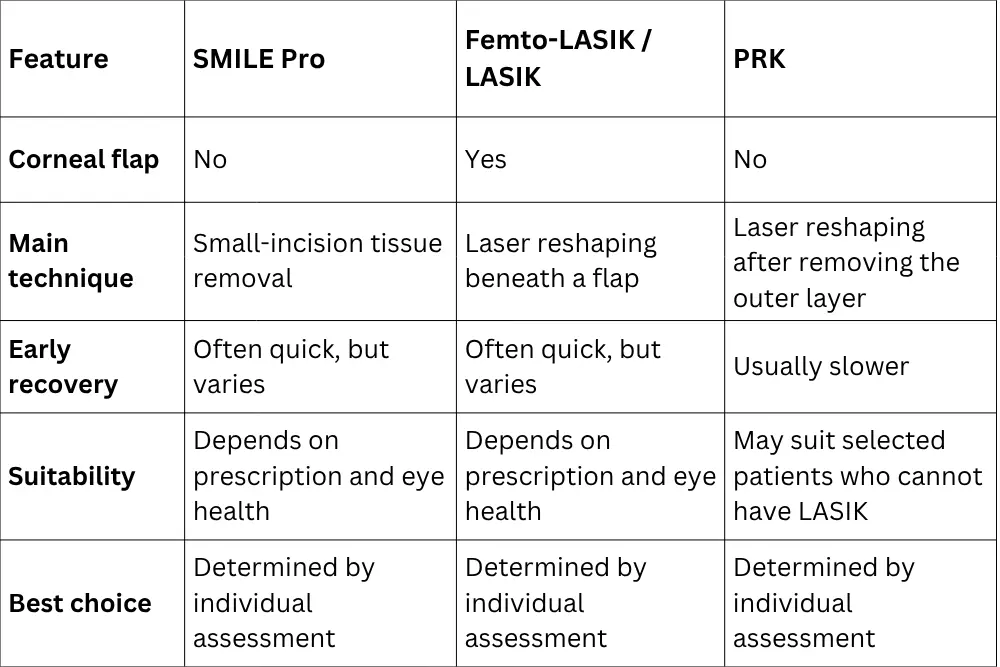
No procedure is automatically better for everyone. Your eye measurements, prescription, corneal health, tear film, and lifestyle all influence the recommendation.
The best procedure is the one that suits your eyes and visual needs, not necessarily the newest or most popular option. An ophthalmologist will consider several factors before recommending surgery.
The type and degree of refractive error help determine which procedure may be appropriate. Some procedures are better suited to particular prescriptions, while others may be considered when the prescription falls outside the treatment range of a specific laser.
The surgeon will measure your cornea's thickness, curvature, and overall health. These measurements help determine whether reshaping the cornea is safe and which technique may be suitable.
Existing dry eye symptoms, corneal conditions, glaucoma, and other eye problems may affect your suitability for surgery. Some conditions need to be treated or assessed before a procedure can be considered.
Your occupation, sports activities, daily routine, and recovery expectations may influence the choice. For example, a procedure without a corneal flap may be worth discussing if you participate in contact sports, although it does not eliminate every surgical risk.
Laser eye correction is generally considered for adults with a stable prescription. People experiencing age-related difficulty with near vision may need a different approach, such as a procedure designed to address presbyopia.
A detailed examination is essential because not everyone who wears glasses or contact lenses is a suitable candidate for laser surgery.
SMILE Pro and LASIK can both provide effective vision correction for suitable patients, but they use different surgical techniques. SMILE Pro does not require a corneal flap and uses a small incision to remove a piece of tissue from within the cornea. LASIK involves creating a flap before reshaping the underlying tissue. Neither procedure is universally better. The right choice depends on your prescription, corneal measurements, tear film, eye health, and visual goals. If you are considering SMILE Pro, you can explore the SMILE Pro procedure at Abate Eye Hospital and discuss your eligibility with an ophthalmologist.
Your eye specialist will conduct a comprehensive evaluation, which may include:
If you wear contact lenses, your surgeon may ask you to stop wearing them for a specified period before the assessment because they can temporarily affect corneal measurements.
Recovery varies according to the procedure and individual healing. Your doctor will provide specific instructions, which may include:
Some people experience temporary dryness, light sensitivity, glare, halos, or blurred vision. Although many patients achieve good vision, laser surgery cannot guarantee perfect eyesight or freedom from glasses in every situation.
Yes. If laser surgery is unsuitable, other options may be available depending on your prescription and eye health.
These alternatives have their own eligibility requirements and risks. Your ophthalmologist can explain which options are appropriate for you.
At Abate Eye Hospital, patients can explore different vision correction options based on their prescription, corneal health, and lifestyle. Available options include SMILE Pro, Femto-LASIK, LASIK, PRK, ICL, and PRESBYOND for selected patients. The appropriate treatment depends on a detailed eye evaluation rather than the procedure name alone. If you are looking for vision correction surgery in Kerala, an eligibility assessment can help you understand your options and make an informed decision.
There is no single best procedure for everyone. SMILE Pro, LASIK, Femto-LASIK, and PRK can all be suitable for selected patients. The right option depends on your prescription, corneal health, and individual needs.
SMILE Pro avoids creating a corneal flap, whereas Femto-LASIK uses a flap. Both can be effective, but suitability and expected outcomes differ between individuals. An eye examination helps determine which is more appropriate.
Laser eye correction permanently changes the shape of the cornea, but it does not stop the eyes from changing with age. Some people may develop residual or recurrent refractive error, and age-related near-vision changes can still occur.
Recovery depends on the procedure and the individual. Many patients notice improved vision within a short period after SMILE Pro or LASIK, while PRK usually takes longer for vision to stabilise. Your surgeon will advise you about returning to work, driving, and other activities.
People with unstable prescriptions, certain corneal conditions, significant dry eye, or some other eye or health problems may not be suitable for particular procedures. A specialist assessment is needed to determine eligibility and discuss alternatives.
Possibly. Suitability depends on the exact prescription, corneal measurements, and overall eye health. Some patients may be considered for alternatives such as ICL if corneal laser surgery is not appropriate.
So, what is the best laser eye correction? The answer depends on your eyes. SMILE Pro offers a small-incision, flapless approach; LASIK and Femto-LASIK can provide rapid visual recovery for suitable patients; and PRK may be an option in selected cases. The most important step is to undergo a comprehensive eye examination and discuss the benefits, limitations, and risks of each option with an ophthalmologist. This helps you choose a procedure based on your individual needs rather than technology alone.