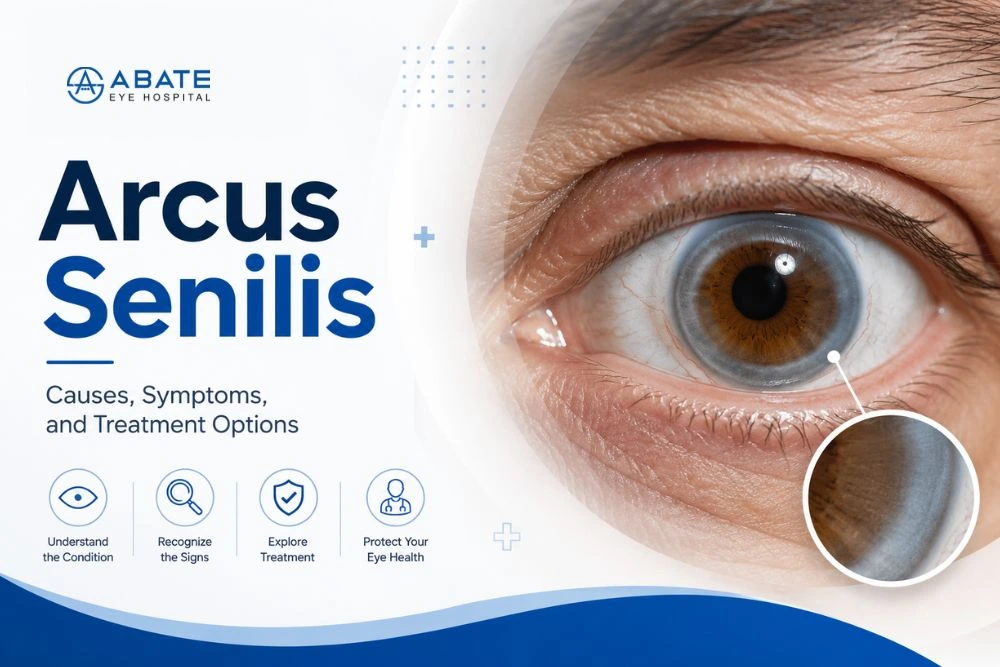
Have you noticed a grey, white, or bluish ring around the colored part of your eye? This condition is known as arcus senilis. It is a common age-related eye change that usually develops in older adults and is generally harmless. While it does not typically affect vision, its appearance can sometimes raise concerns, especially when it occurs in younger individuals.
In older adults, arcus senilis is often considered a normal part of ageing. But then again, when it develops at less than 45 years of age, it can indicate high blood cholesterol or lipid diseases and thus calls for a thorough eye examination and checkup.
This guide explains everything you need to know about arcus senilis, including its causes, symptoms, diagnosis, treatment options, and when you should consult an eye specialist.
Arcus senilis is a grayish-white or bluish ring that forms around the edge of the cornea, the clear front surface of the eye. The ring develops due to the deposition of cholesterol and other fats (lipids) within the outer layer of the cornea.
The condition usually appears:
Because the deposits are located at the edge of the cornea, they do not interfere with the passage of light into the eye.
Arcus senilis develops when lipids gradually accumulate within the peripheral cornea over time. This process is most commonly associated with natural ageing.
As people grow older, small amounts of cholesterol and other fatty substances may collect in the corneal tissue, creating the characteristic circular ring.
Several factors may contribute to the development of arcus senilis.
The most common cause is aging. It is frequently seen in people over the age of 60 and becomes more common with increasing age.
In younger adults, arcus senilis may be associated with elevated cholesterol or abnormal blood lipid levels.
Doctors may recommend cholesterol testing if the condition develops at a young age.
Some individuals may have a genetic tendency to develop lipid disorders that increase the likelihood of early arcus senilis.
Conditions that may contribute include:
These factors may increase the risk of lipid accumulation throughout the body.
Most people have no symptoms other than the visible ring.
Common characteristics include:
Because it usually does not affect eyesight, many people discover it during a routine eye examination.
No. Arcus senilis does not usually affect vision.
The deposits remain at the outer edge of the cornea and do not interfere with the central area responsible for transmitting light.
Most people continue to see normally despite the presence of the ring.
Doctors often distinguish between two forms.
Early onset should always be investigated.
In older adults, arcus senilis is generally harmless.
However, younger individuals should not ignore the condition because it may indicate underlying lipid abnormalities that require treatment.
An eye examination combined with blood tests can help identify any underlying health concerns.
An ophthalmologist can usually diagnose arcus senilis during a routine eye examination.
The evaluation may include:
The slit lamp allows the doctor to clearly visualize the lipid deposits around the cornea.
Age-related arcus senilis cannot always be prevented.
However, maintaining good cardiovascular health may help reduce the risk of early lipid-related eye changes.
Healthy habits include:
These measures support both eye health and overall well-being.
Most older adults do not require treatment because the condition does not affect vision.
Treatment is generally unnecessary unless an underlying medical condition is identified.
If blood tests reveal elevated cholesterol levels, treatment may include:
Managing cholesterol supports both heart and eye health.
No. There is no medical or surgical treatment designed to remove the corneal ring.
Since arcus senilis does not interfere with vision or damage the eye, removal is generally not recommended.
The focus should be on identifying and treating any underlying health conditions rather than removing the ring itself.
Schedule an eye examination if you notice:
Prompt evaluation helps rule out other eye diseases and detect any associated health conditions. At Abate Eye Hospital, you will get consultation from the best eye doctor in Kerala and Chennai. So, if you are facing issues with your eyes, you can contact an eye hospital like Abate.
Several eye conditions can resemble arcus senilis.
These include:
Only a comprehensive eye examination can accurately determine the cause.
Routine eye checkups are important even if vision seems normal.
Regular examinations help:
Early detection often leads to better long-term outcomes.
At Abate Eye Hospital, experienced ophthalmologists provide detailed eye examinations using advanced diagnostic technology to evaluate conditions such as arcus senilis and other corneal abnormalities. Every patient receives a comprehensive assessment to determine whether the condition is simply age-related or linked to underlying health concerns.
The hospital offers:
With modern ophthalmic facilities, Abate Eye Hospital in Chennai and Kerala delivers reliable eye care focused on accurate diagnosis, prevention, and long-term vision health.
Arcus senilis is a common age-related eye condition characterized by a gray or white ring around the cornea. In older adults, it is usually harmless and does not affect vision. However, when it develops in younger individuals, it may be an early sign of high cholesterol or other lipid disorders that require medical attention.
If you notice a ring around your cornea or experience any changes in your vision, consult an eye specialist for a thorough evaluation. Early diagnosis not only helps protect your eye health but may also uncover important information about your overall health.
In older adults, not necessarily. However, if it appears before the age of 45, it may be associated with high cholesterol or other lipid disorders.
No. Arcus senilis usually does not interfere with vision because it develops around the edge of the cornea.
No. The corneal ring typically remains, but it is generally harmless and does not require treatment.
Yes. It is a common age-related finding, especially in people over 60 years of age.
Yes. A comprehensive eye examination can confirm whether it is arcus senilis or another eye condition and determine if further medical evaluation is needed.